
Der Schwangerschaftstest misst das Hormon hCG (Humanes Choriongonadotropin), das erst nach der Einnistung der befruchteten Eizelle produziert wird. Ist der hCG-Spiegel im Urin noch zu niedrig, zeigt der Test kein positives Ergebnis – auch wenn bereits eine Schwangerschaft besteht.
Wie schnell der Hormonspiegel ansteigt, ist individuell verschieden. Die oft beworbene „99-prozentige Zuverlässigkeit“ gilt in klinischen Studien nahezu ausschließlich ab dem Tag der ausgebliebenen Periode. Ein negativer Test zehn Tage nach dem Eisprung ist daher kein endgültiges Ergebnis.
From Ovulation to Implantation: The Biological Timeline of the hCG Signal
Das Hormon hCG wird erst produziert, wenn sich eine befruchtete Eizelle in der Gebärmutterschleimhaut eingenistet hat (Nidation). Bis dahin ist noch kein hCG vorhanden.
Der biologische Ablauf:
- Tag 0–1: Eisprung und mögliche Befruchtung.
- Tag 2–5: Die befruchtete Eizelle wandert durch den Eileiter in Richtung Gebärmutter.
- Tag 6–10 (Nidation): Die Eizelle nistet sich ein. Erst jetzt beginnt die hCG-Produktion.
- Tag 10–14: Das Hormon reichert sich im Blut an und wird schließlich auch im Urin messbar.
Nach der Einnistung verdoppelt sich die hCG-Menge etwa alle 48 bis 72 Stunden. Ist die Konzentration im Urin noch zu gering, schlägt der Test nicht an. Frühestens 10 bis 12 Tage nach dem Eisprung ist hCG im Urin nachweisbar. Bereits zwei Tage Unterschied beim Testzeitpunkt können das Ergebnis deutlich verändern.

Sensitivität von Schwangerschaftsfrühtests: 10 mIU/ml vs. 25 mIU/ml
Auf den Verpackungen findet sich oft die Einheit mIU/ml (Milli-Internationale Einheiten pro Milliliter). Je kleiner dieser Wert, desto geringere Mengen hCG kann der Test nachweisen – und desto früher kann er anschlagen.
- Ultra-Early Test (10 mIU/ml): Kann im Idealfall bis zu vier Tage vor der erwarteten Periode eine Schwangerschaft anzeigen – also etwa ab Tag 10 nach dem Eisprung.
- Standard test (25 mIU/ml): Benötigt eine höhere Hormonkonzentration und ist für die Anwendung ab dem Tag der fälligen Periode gedacht.
Wer vier Tage vor der erwarteten Periode einen Standardtest verwendet, wird fast immer ein negatives Ergebnis sehen – weil der Körper zu diesem Zeitpunkt noch keine ausreichend hohe Hormonkonzentration aufgebaut hat.
Auch ein 10er-Test ist keine Garantie. Wenn der Körper noch nicht genug hCG produziert, bleibt auch der empfindlichste Test negativ. Ein negatives Ergebnis kurz vor der Periode schließt eine Schwangerschaft nicht aus.
Warum „99 % zuverlässig“ vor der Periode irreführend ist
„Über 99 % zuverlässig“ steht auf fast jeder Verpackung – gilt aber nahezu ausschließlich ab dem Tag der ausgebliebenen Periode. Wer früher testet, riskiert ein falsch-negatives Ergebnis, weil der hCG-Wert im Urin noch unterhalb der Nachweisgrenze liegt.
Klinische Daten zur tatsächlichen Erkennungsrate:
- 4 days before period (approx. ovulation + 10): Nur etwa 50–55 % der bestehenden Schwangerschaften werden erkannt.
- 3 days before period (approx. ovulation + 11 days): Die Erkennungsrate steigt auf rund 84 %.
- 2 days before period (approx. ovulation day + 12): About 92% of the tests yield a correct positive result.
- On the day of your expected period (DPO 14): Erst jetzt wird die Schwelle von 99 % erreicht.
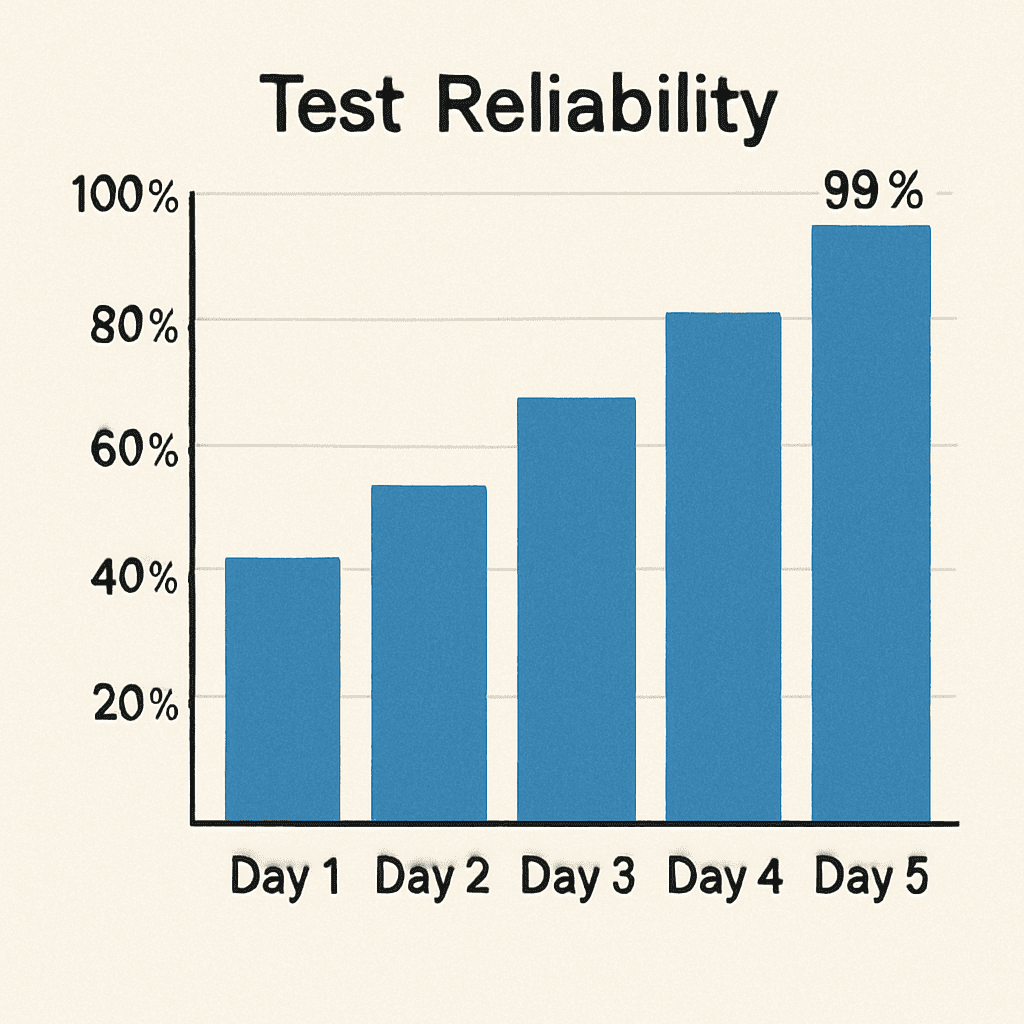
Such huge leaps in numbers impressively illustrate why too early a test date can bring more frustration than clarity. For example, if you test four days beforehand and the field remains blank, you've essentially only gotten a 50/50 chance – just like flipping a coin. Nobody likes to flip a coin to answer such an emotional question, yet we do almost the same thing when we give in to impatience too soon.
So don't blame yourself if you tested early and were disappointed, but keep your hope a little longer. The best course of action for an early, negative test is simple: Save your money and your nerves, wait 48 hours, and try again. In addition to the right day, urine concentration and avoiding errors also play a crucial role in obtaining a correct result.
Morning urine and application errors: How to maximize your chances of a correct result
Even the most sensitive test is of little use if the hormone you're looking for is too diluted in the body. If you drink a lot of water during the day, the small amount of hCG that's already low before your period will be spread across significantly more fluid. Our proverbial „sentinel“ in the test strip will then have an extremely difficult time finding the few messenger substances at all. This is precisely why the concentration of the pregnancy hormone is highest in morning urine. Overnight, hCG accumulates and builds up in the bladder, making this first trip to the toilet after waking up the perfect time for an early test.
To ensure nothing goes wrong in this already nerve-wracking situation, a reliable routine helps. A guide on how to correctly use a pregnancy test requires only four crucial steps:
- Protection Unpack the test only immediately before use to protect the sensitive field from normal humidity.
- Contact: Hold the absorbent tip in the urine stream (or in a clean cup) for exactly as long as the insert sheet specifies.
- Location: Lay the test flat on a dry surface. A tilted strip can cause the liquid to run incorrectly.
- Timing: Be sure to set a mobile phone alarm for the exact reading time window – typically after 3 to 5 minutes.
This last point, in particular, is often underestimated, as looking at the test field later can cause enormous confusion. If the urine dries on the strip after the official reading time has expired, a colorless mark often appears. Many women then spend hours puzzling over whether they are looking at an evaporation line or a faintly positive line. The rule of thumb for distinguishing between them is simple: a real, positive line appears within the specified minutes and shimmers in color – usually a delicate pink or blue. An evaporation line, on the other hand, appears much later, looks like a grayish shadow, and is unfortunately not proof of pregnancy.
A test performed exactly according to instructions and with the first urine of the day provides you with the most reliable result that is biologically possible at this time. Nevertheless, our body is not a machine. If the test is negative despite all care and clear symptoms, there can be various reasons for this.
Negative despite symptoms? The pitfalls of early testing and when you should repeat
Waiting for clarity is nerve-wracking, especially when your own body seems to be sending clear signals. You feel a pulling in your lower abdomen, your breasts are tender, the fatigue is overwhelming – and yet the test's viewing window remains a shining white. This contradiction between intense bodily sensations and a negative result plunges many women into an emotional rollercoaster of hope and disappointment. Often, you're left feeling insecure, wondering if you're just imagining the signs or if the test is simply wrong.
Behind this irritating phenomenon usually lies a simple biological misunderstanding called progesterone symptomology. After every ovulation, your body produces the hormone progesterone to prepare the uterus for a possible implantation. It is precisely this substance that causes typical PMS symptoms, which can feel exactly like early pregnancy symptoms. However, as long as no fertilized egg has actually implanted, your body is not yet emitting any measurable hCG that a test could react to.
Even if you choose a highly sensitive model for your early pregnancy test, the hormone level in your urine must first reach a certain threshold for the proverbial indicator on the test strip to show a result. A look at an hCG value chart after implantation clarifies that hormone production begins microscopically in the first few days and increases at a completely individual rate for each woman. So if your ovulation was only delayed by two days, it's simply too early for detection, even if you instinctively sense the first physical changes.
The most effective strategy against this draining guesswork is the 48-hour rule, as hCG levels in early pregnancy are known to double approximately every two days. Instead of immediately grabbing the next test strip the following morning, spare your nerves and your wallet by consciously waiting. If a pregnancy test is negative despite a missed period, it doesn't necessarily mean the end for this cycle. Often, the cycle has simply shifted slightly, so the hormone level simply needs a few more days to provide a reliable result.
This waiting period between fear and hope requires a lot of patience, but with the right equipment, it can at least be made less stressful during the next round. After all, when the next attempt is scheduled in two days, you don't want to be sitting in front of an ambiguous shadow and guessing again. Choosing the right test device – whether digital or a strip – plays a crucial role in your peace of mind.
Digital vs. Strip: Which Format Offers the Best Clarity for Your Nerves?
Standing by the window with a test strip in the morning light and wondering if there's a faint second line or just a shadow can be incredibly nerve-wracking. Classic strip tests require your own „optical interpretation,“ where your eyes alone have to decide if the hormone signal was strong enough for a visible color change. This often leads to desperate guessing and comparing photos with your best friend rather than the quick certainty you were hoping for in the bathroom.
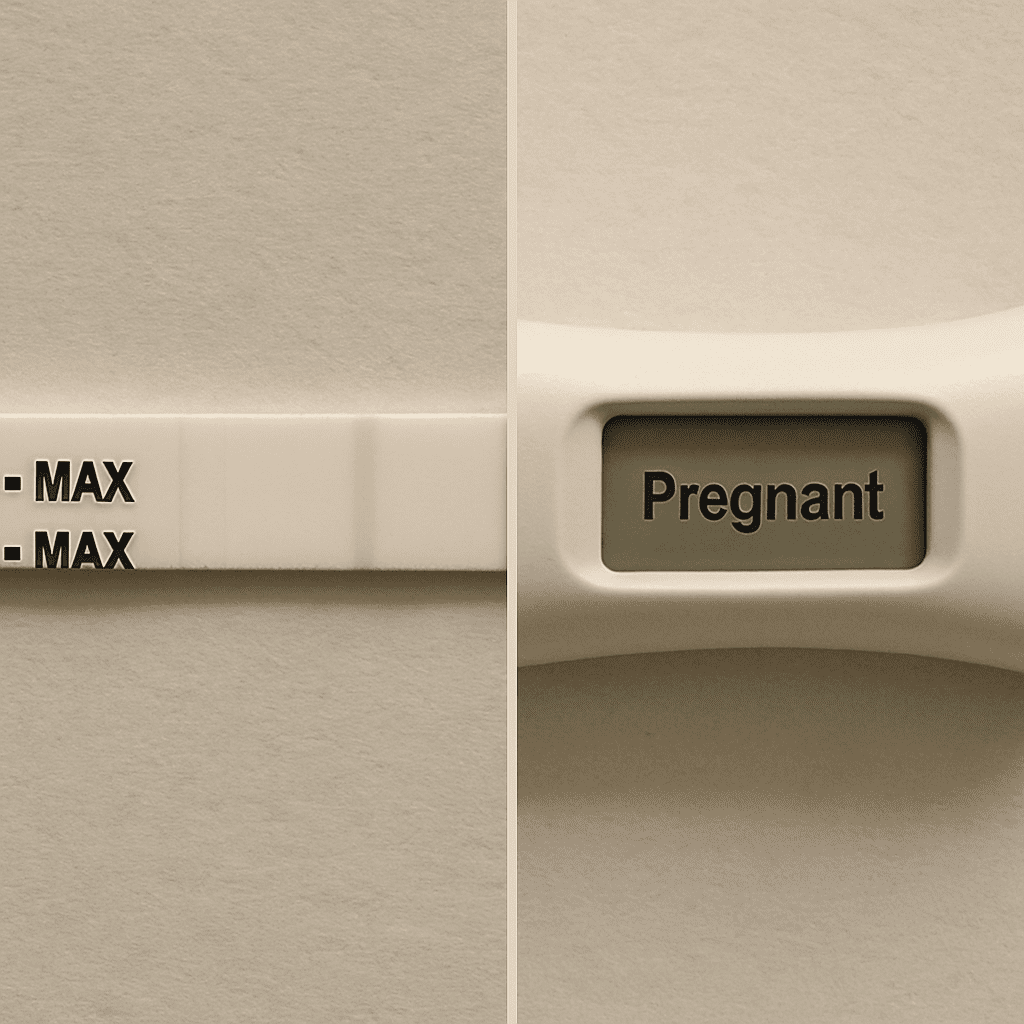
Digital models take this guesswork out of the equation with an internal „digital evaluation,“ translating the chemical reaction into a clear text word like „Pregnant“ or „Not Pregnant.“ However, this convenience often comes with a hidden trade-off in sensitivity. Many women rightly wonder: When is a 10-count test reliable? to read? A classic analog Early pregnancy test While a sensitivity of 10 mIU/ml often reacts to the tiniest amounts of hCG, it forces you to guess at the lines. A digital test, on the other hand, often requires a slightly higher hormone concentration to trigger the display correctly in the first place and could show a false negative if testing very early.
To weigh Digital pregnancy test vs. strip test Making the right choice for your nerves, a closer look at the daily pros and cons of both options helps:
- Cost factor Analog strips are extremely budget-friendly and ideal if you're applying the 48-hour rule and want to test multiple times.
- Clarity The digital screen eliminates any optical illusions with gray evaporation lines and protects you from nerve-wracking misinterpretations.
- Sensitivity Analog early tests often detect biochemically one to two days earlier than standard digital tests, but they require a very keen eye.
The cleverest strategy therefore often combines both formats to spare both your wallet and your psyche. Use the inexpensive strip tests for the first cautious attempts before your expected period, and save the more expensive digital model for the moment when you want to confirm a faint analog line, finally and in black and white. A pragmatically structured testing situation optimally prepares you for the final result and ensures the necessary peace of mind.
Your roadmap to a secure outcome: The summary for peace of mind.
No one has to stand in the drugstore guessing anymore, wondering which package holds the magic answer. With knowledge of one's own body's biological clock, bold marketing promises can be separated from physiological reality. A Early pregnancy test is not a time machine, but merely a highly sensitive instrument that waits for the body's individual hormone signals to reach a specific, measurable threshold.
The most important rule when asking a question, in a Early pregnancy test from when whether an intervention is worthwhile can be reduced to patience and the hCG value. Those who wonder, When is a 10-pack test reliable?, must know: While these sensitive tests can sometimes detect a pregnancy a few days earlier, their true 99 percent reliability only becomes apparent on the day of the missed period. The golden rule of early testing is: A faint or clear „yes“ today is almost certainly a yes, but a „no“ today is not a „no“ forever – it often just means the test was taken a little too early.
To save emotional energy and avoid wasting money on unnecessary tests, this simple test plan helps:
- Wait and see Give your body time. Wait until at least three days before your expected period, ideally until the actual due date.
- Testen: Always use the first morning urine, as it contains the highest and most concentrated amount of the pregnancy hormone.
- Repeat If the result is negative and your period hasn't arrived yet, wait a full 48 hours and test again so that hormone levels can double.
For maximum peace of mind, it's best to wait until the actual day of your missed period. Although the two-week wait is undoubtedly nerve-wracking, testing later spares you the anxiety of interpreting faint evaporation lines or questioning whether a negative result was just a false alarm.
With knowledge of the science behind pregnancy tests, you can confidently control the timing of your test. Instead of losing hope through a premature negative result, the next step can be taken with the certainty of when your body is truly ready to share its answer. Take a deep breath, trust your body's natural timeline, and then test when the moment is biologically right.
